

Two Nigerian browser games, released days apart, and what they show anyone who wants to launch the next big product: Lagos Life and Lagos Run.
Lagos Life and Lagos Run are two Nigerian browser games that launched just days apart, and their early success says something important about building the next big product.
On 26 September, Nigerian developer Opeyemi Adeniran, a Berlin-based frontend engineer who posts online as Eureka, released Lagos Run, a browser game that puts players behind the wheel of a danfo in Lagos. The game quickly attracted thousands of players, with figures later shared by Adeniran showing 7,000 players in its first two days and more than 27,000 shortly afterwards. Later reporting put its audience above 90,000 by the end of that week. [2][10]
Five days later, on 1 October, Shalom Rayhamen launched Lagos Life. This time, players were not simply driving through Lagos. They were living in it: creating characters, finding jobs, earning and spending virtual money, paying rent, moving around the city and interacting with other players in a shared virtual environment. [1][3][4]
By 5 October, Lagos Life’s own dashboard showed 1,212,477 total players, 71,625 people online and more than 9.6 million visits. Those numbers come from the developer’s dashboard and have not been independently audited, so they should be treated as developer-reported figures. Even with that qualification, the response is significant. [1]
That is what makes Lagos Life and Lagos Run worth studying.
The useful question is not simply whether you are building the next Lagos Life or Lagos Run. It is what these products reveal about building something people want, removing the barriers between them and the product, and giving a familiar idea enough local character that people feel it was made for them.
The bigger opportunity is not copying either game.
It is learning how they turned familiar ideas into something distinctly Nigerian.
The Sims 3 was only the starting point as insights for Nigerian browser games like Lagos Life and Lagos Run
Shalom has said that she grew up playing The Sims 3 and wondered what the game might look like if its characters lived in a world inspired by her own. [3][4]
It’s important because the basic format of Lagos Life was not new.
Life simulation is an established genre. Players have spent years creating characters, managing money and needs, working jobs, building homes and navigating simulated social lives.
What Shalom changed was the setting.
Lagos Life takes familiar life-simulation mechanics and places them inside a world Nigerian players immediately recognise. Players can begin in different financial circumstances, including the game’s “Nepo” and “Lapo” starting conditions, then navigate work, money, rent, social life, and familiar Lagos locations such as Amala Shitta and Quilox. [1][3][4]
The local references are not simply decoration.
They are part of the experience.
A developer anywhere in the world can reproduce the mechanics of a life simulator. It is much harder to reproduce the cultural knowledge behind the humour, the language, the social references, and the everyday financial anxieties that make the environment instantly recognisable to Nigerian players.
The format is familiar.
The context is the differentiator.
Lagos Run was not the first danfo game

There is another reason Lagos Run is worth studying: the idea itself was not new.
ChopUp’s Danfo series dates back to 2007, and the company says it has reached more than 700,000 gamers. Gamsole later released Gidi Run, while other Nigerian developers also built games around Lagos transport and street life. [5][6]
Gidi Run is especially useful as a historical comparison. BusinessDay reported that Gamsole’s game reached 100,000 paying subscribers through an MTN partnership in 2016, showing that Nigerian developers had already found audiences for culturally familiar games before Lagos Run. [5]
So what changed?
Distribution.
Lagos Run is played directly in a browser. There is no traditional app-store installation journey, no account creation before the game begins, and no payment barrier. A user can open a shared link and start playing. The game was also designed with local connectivity realities in mind, including local browser storage and offline behaviour after the initial load. [2]
That sounds like a small technical decision.
It is actually a product decision.
For someone discovering a game through a WhatsApp group, X post or friend’s message, there is a huge difference between:
“Tap this link and play.”
and:
“Search for this app, download it, install it, create an account and then see whether you like it.”
Every extra step creates another opportunity for curiosity to disappear.
The launch of Lagos Run became part of the product
Adeniran also treated the release as something that could evolve in public.
Players posted scores, challenged friends, and suggested changes. He responded with updates, including changes to visibility and gameplay based on feedback. A WhatsApp channel was also created so players could contribute suggestions. [2][10]
That approach matters because the first version of a product does not need to contain everything.
It needs to give people something real enough to react to.
A developer can spend six months imagining what users might want.
Or a developer can launch a smaller version, watch what people actually do, and make the next decision from evidence.
The latter approach is not always easier.
But it is often faster.
Then Lagos Life arrived
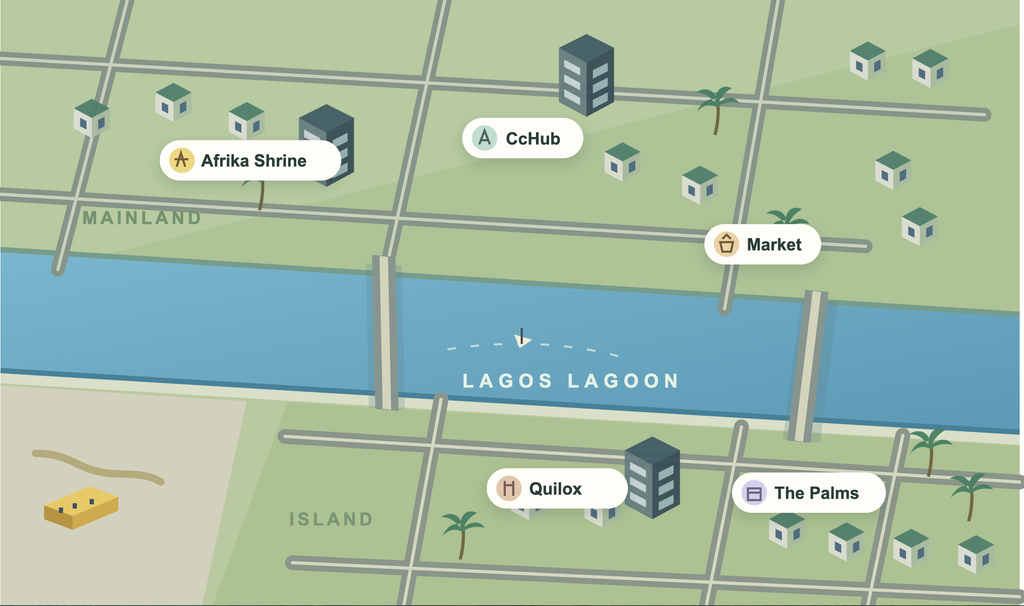
The relationship between the two games is even more interesting than the competition between them.
Shalom has said that seeing Lagos Run helped push her toward expanding the idea beyond one danfo game into a broader virtual Lagos. Both Arise and BusinessDay reported that connection. [3][4]
That does not mean Lagos Life simply copied Lagos Run.
The two products are fundamentally different.
One turns Lagos transport into a game.
The other turns an entire version of Lagos life into a game.
But the timing matters.
For several days, people were already talking about a Nigerian browser game built around a familiar part of Lagos. Then another developer introduced a much larger interpretation of the same idea: what if the city itself became the playground?
Whether Lagos Run directly caused part of Lagos Life’s eventual audience is impossible to measure from the available evidence.
What can be observed is that one product helped demonstrate that there was an audience willing to play inside a recognisably Nigerian digital world.
Sometimes innovation works this way.
One product proves the door can be opened.
Another asks what is behind it.
The city is the differentiator
At the mechanical level, neither game is particularly mysterious.
Lagos Run uses a familiar endless-runner structure: steer, avoid obstacles, collect rewards, pick up passengers and keep moving. Lagos Life uses life-simulation mechanics: create a character, work, earn, spend, socialise and manage a virtual life. [1][2]
The differentiator is what surrounds those mechanics.
In Lagos Run, the danfo, bus stops, passengers, okadas, traffic, road obstacles and radio create a recognisable Lagos environment. Adeniran has also connected the game to memories of Lagos, particularly Ojuelegba, where he grew up. [2][10]
In Lagos Life, that same idea is expanded across the entire simulation. Money pressure, jobs, rent, neighbourhoods, nightlife, local humour, music and familiar locations become part of the mechanics rather than simply the scenery. [3][4]
That may be the most important lesson for builders outside gaming.
You do not always need to invent a new behaviour.
Sometimes you need to take a behaviour people already understand and make it feel as though it was built specifically for them.
The metaverse lesson is hiding in plain sight
For years, the metaverse was often presented through headsets, avatars, virtual property and giant digital spaces.
Lagos Life contains several of those ideas without asking users to buy a headset.
It is a persistent social environment involving avatars, jobs, property, brands, entertainment, money and interaction with other players. Its official disclaimer describes the game as a fictional simulation inspired by Nigerian life, while its Terms state that in-game naira, properties, items and jobs have no real-world value and cannot be cashed out. [7][8]
That distinction is important.
The interesting part is not whether the game deserves the label “metaverse”.
It is why people enter.
They are not necessarily joining because the technology is impressive.
They are joining because the environment is recognisable.
The city provides the reason to care.
For product builders, that is a useful correction to the old metaverse pitch.
A shared digital world becomes more compelling when people already have a reason to want to be there.
AI lowers the build cost. It does not replace cultural knowledge.
Adeniran’s development story is another part of this shift.
He has said that building a project like Lagos Run would have taken months, if not several years, ago, but AI tools allowed him to move from idea to a working game much faster. Reporting also describes him using AI-generated graphics and Claude during development. [2][10]
That does not mean AI has eliminated the need for developers.
It means the cost of experimentation is falling.
And when implementation gets cheaper, other advantages become more important.
Customer understanding.
Product judgement.
Taste.
Distribution.
Cultural knowledge.
The ability to identify an idea worth testing.
A developer can increasingly get help producing code, graphics and prototypes.
The harder question remains:
What should you build?
That is where cultural understanding becomes an advantage.
A copy of a successful game can appear surprisingly quickly. Techpoint reported that a London “Red Bus” version appeared after Lagos Run gained attention, while other developers began experimenting with variations around the broader formula. [1]
Code can be copied quickly.
Understanding why something resonated in the first place takes much longer.
What to take from Lagos Life and Lagos Run
Do not set out to build the next Lagos Life.
It already exists.
Do not build a slightly different Lagos Run simply because the original proved that the idea can spread.
The opportunity is in understanding the method behind them.
1. Start with something you know from the inside
Adeniran’s game draws from familiarity with Lagos and experiences of living there. Shalom’s game draws from her experience with life-simulation games and her interest in what that format could become in a Nigerian setting. [3][4][10]
That inside knowledge becomes an advantage.
For a young developer or entrepreneur, the equivalent might be a school routine, transport problem, local logistics process, creator workflow, market behaviour, community habit, or payment problem that outsiders understand only superficially.
You may be closer to a product idea than you think.
2. Remove every unnecessary step
The browser was not merely a technical choice for Lagos Run.
It was a distribution strategy.
The fewer barriers between discovery and value, the easier it is for curiosity to become usage.
This is especially important in markets where storage, device limitations, data costs, and connectivity can influence adoption. [2][4]
Build around the actual conditions your users live with, not the conditions you wish they had.
3. Ship while people are still interested
A working product gives users something to react to.
The public iteration around Lagos Run shows what can happen when feedback becomes part of development rather than something collected after a “final” launch. [2]
The feedback loop can become a competitive advantage.
4. Design for natural sharing
The best products do not always need to tell users to market them.
A score can become a post.
A funny situation can become a screenshot.
Surprising outcome can become a conversation.
A familiar reference can make someone tag a friend who immediately understands the joke.
Lagos Life benefited heavily from the same kind of cultural conversation, while Lagos Run became part of people’s social feeds through shared scores and gameplay moments. [1][2][4]
The product itself becomes part of the distribution.
5. Know how the business could make money before the crowd arrives
This is where Lagos Life provides a particularly interesting case.
Techpoint reported that the game began monetising through in-world advertising, with businesses able to rent virtual billboards and other spaces. At the time of its report, 38 billboards were available at ₦5,000 per week, while sea plots and other placements were also being sold. The game had also started charging more for premium placement as demand increased. [1]
That does not mean virtual advertising automatically creates a sustainable business.
The developer has not publicly disclosed total revenue or operating costs.
But it shows something valuable:
Monetisation can be part of the product design from the beginning.
The historical example of Gidi Run offers a different model. Its 100,000 paying subscribers came through MTN’s game platform, demonstrating the importance of distribution partnerships in a market where app-store discovery alone can be difficult. [5]
Distribution and monetisation are different questions.
Good products need answers to both.
6. Treat security and the economy as part of the product
Lagos Life also provides a less glamorous but more important lesson.
Its rapidly growing virtual economy was hit by an exploit that allowed some players to generate huge quantities of virtual money. Reporting from Arise and BusinessDay describes the resulting disruption and the developer’s decision to reset affected funds and fix the vulnerability. [3][4]
That is not just a gaming lesson.
It applies to fintech products, marketplaces, loyalty programmes, referral systems, online communities and any product where digital value can be manipulated.
If your product contains balances, rewards, rankings, possessions or transactions, assume someone will eventually test the boundaries.
Build the controls before the crowd arrives.
7. Put the rules in writing
Lagos Life’s official Terms set out who can play, account rules, and how its virtual economy works. Its disclaimer is equally clear that the game is fictional and that its Game Naira is not Nigerian legal tender, cannot be withdrawn, and does not represent real-world monetary value. [7][8]
As a product grows, clarity around what it is, and what it is not becomes part of the product.
What is still untapped?
The bigger opportunity may not even be gaming.
Lagos Life and Lagos Run are examples of a broader product formula:
Take a proven format.
Combine it with a place, community, or problem you understand unusually well.
Deliver it in a way that fits how people in that market actually use technology.
That can apply to games.
But it can also apply to software.
Examples like:
- Local-language learning product.
- Transport tool built around how a particular city actually moves.
- School-fee workflow designed around local payment behaviour.
- Booking product that understands how small businesses in a particular market operate.
- Creator tool that takes local data costs and payment methods seriously.
- Marketplace designed around how people already buy and sell, rather than how a global product assumes they do.
Niko Partners’ research on MENA-3 — Saudi Arabia, the UAE and Egypt points to a similar opportunity around localisation, platform behaviour and market-specific conditions. Its 2025 research projects the three-market games sector at $2.2 billion in revenue in 2025, growing to $2.8 billion by 2029. [9]
That figure is for MENA-3, not the whole of Africa and the Middle East.
The broader point is more useful:
- Analyze how consumer behaviors shift from market to market.
- Navigate the specific constraints inherent to each environment.
- Decode the unique cultural references of your target audience.
- Adapt to localized payment habits to secure smooth transactions.
- Capitalize on the new opportunities that each region opens up.
The builder who understands those differences has an advantage.
So, are you building the next Lagos Life or Lagos Run?
That may be the wrong question.
Ask instead:
What do you understand about a place, community, or daily routine that an outsider would struggle to reproduce?
Then ask:
Which proven product format could make that knowledge useful?
Lagos Run did not invent the endless runner.
Lagos Life did not invent the life simulator.
Their opportunity came from combining familiar formats with local knowledge, reducing friction and giving people something they immediately recognised as their own. [1][2][3][4]
That is the part worth copying.
Look past the danfo.
Disregard the virtual Lagos.
Forget the memes.
Focus entirely on the method.
The next major Nigerian or African digital product may not come from someone trying to build another version of what already went viral.
It may come from someone looking at an ordinary part of everyday life and realising that, with the right format, the right distribution and the right execution, millions of people might actually want to use it.
About Angelose Global
Angelose Global Limited is a Nigerian IT solutions and digital product company working across technical consulting, full-stack development, branding, product design, cloud engineering and data analytics.
The idea behind this article is simple: if you have a product idea rooted in a place or community you understand well, do not start by asking how to copy the latest hit.
Start by asking what you know that others do not, and how technology can turn that knowledge into something people actually want to use.
Sources & Credits
[1] Techpoint Africa — “Lagos Life: Sim-style web game crosses 1m players in 4 days, as virtual billboards foot the bill” — 5 October 2026.
[2] Technext — “Lagos Run is not the first Danfo game: Here’s why it’s the one everyone is playing” — October 2026.
[3] Arise News — “How ‘Lagos Life’ Is Capturing Young Nigerians Online” — 5 October 2026.
[4] BusinessDay — “Lagos Life crosses 1m players as Nigerian-built browser game goes viral” — 5 October 2026.
[5] BusinessDay / Financial Times — “Nigeria’s game designers fight for their cut on mobile” — 3 April 2018.
[6] ChopUp Games — About Us.
[7] Lagos Life — Terms of Service, updated 1 October 2026.
[8] Lagos Life — Game, Brand & Real-World Content Disclaimer, effective 1 October 2026.
[9] Niko Partners — The Future of Gaming in MENA-3: Understanding the Opportunity.
[10] Moveee Magazine — “The Berlin-Based Nigerian Developer Behind the Danfo Game Everyone Is Playing” — 1 October 2026.