


A digital transformation strategy determines whether enterprise growth becomes sustainable or structurally unstable.
Many organisations invest heavily in cloud platforms, automation tools, and enterprise software under the banner of digital transformation. Yet despite significant budgets and ambitious roadmaps, the results often fall short.
Why?
Because digital transformation fails at the architecture layer, not the tool layer. A scalable IT strategy requires structural planning, governance alignment, and infrastructure modelling before implementation begins.
This guide outlines how to build a digital transformation strategy that supports long-term scalability, security, and measurable performance.

What is a digital transformation strategy?
A digital transformation strategy is a structured plan that aligns.
- Technology architecture
- Business growth objectives
- Data infrastructure
- Governance frameworks
- Scalability thresholds
It’s not a software roadmap. It’s a digital infrastructure strategy designed to evolve operational capability.
Organisations that treat transformation as procurement typically accumulates:
- Integration debt
- Security risk
- Performance bottlenecks
- Redundant systems
Transformation must be architectural, not reactive.
Why Digital Transformation Fails
1. Tool-First Decision Making
Technology selection without infrastructure mapping leads to:
- API overload
- Data fragmentation
- Workflow duplication
- Rising infrastructure costs
Enterprise digital transformation should begin with structural assessment and not vendor evaluation.
2. Undefined Scalability Metrics
Growth projections must be quantified. Ask:
- What happens at 3x user volume?
- What are database concurrency limits?
- Where are single points of failure?
- How is redundancy distributed?
Without modelling demand thresholds, scalability becomes reactive.
3. Governance Misalignment
Digital transformation initiatives often ignore governance frameworks. This creates:
- Access control inconsistencies
- Compliance gaps
- Shadow IT risk
- Audit complications
Governance is not administrative overhead, it’s operational risk management.
The 4-Layer Digital Transformation Strategy Framework
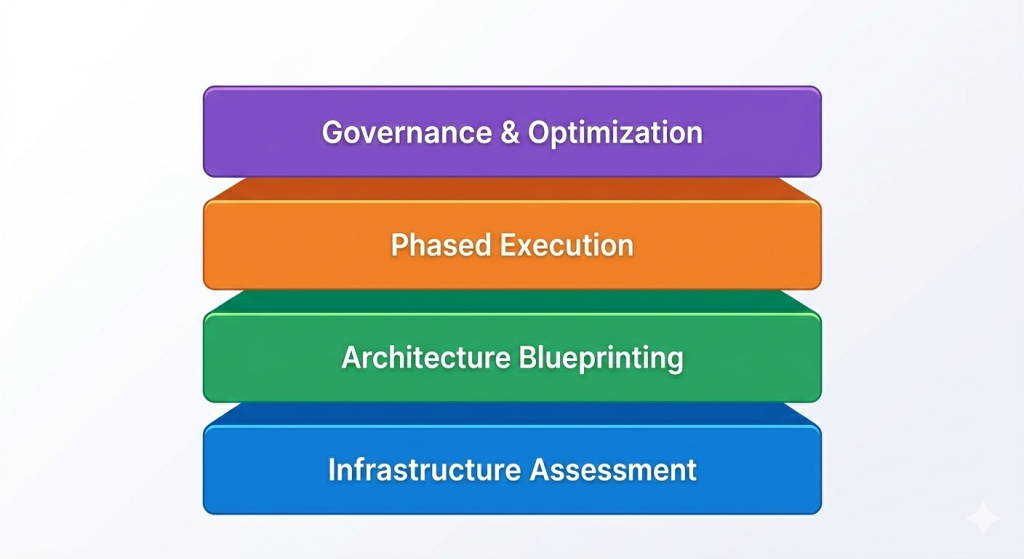
To build a scalable digital transformation strategy, enterprises must operate across four structural layers.
Layer 1: Infrastructure Assessment
Evaluate:
- Current system architecture
- Integration dependencies
- Performance constraints
- Security posture
This stage identifies structural limitations before transformation begins.
Layer 2: Architecture Blueprinting
Define:
- Cloud or hybrid model
- Data flow architecture
- API governance standards
- Scalability thresholds
- Disaster recovery protocols
Blueprinting prevents technical debt accumulation during expansion.
Layer 3: Phased Execution Model
Transformation must be iterative. Phased deployment allows:
- Controlled risk exposure
- Performance monitoring
- Cost optimization tracking
- System stability validation
Large-scale transformation without phasing increases operational instability.
Layer 4: Governance & Optimization
Sustainable digital transformation requires:
- Role-based access control
- Continuous monitoring
- Performance analytics
- Cost governance policies
- Security patch discipline
Transformation is an ongoing structural discipline, not a one-time initiative.
Signs Your Organization Is Not Architecturally Ready
You may need a digital infrastructure strategy review if:
- Infrastructure documentation is incomplete
- Integration standards vary across teams
- Scalability metrics are undefined
- Security protocols are reactive
- Deployment cycles are slowing
These signals indicate architectural strain.
Strategy Before Acceleration

A digital transformation strategy should reduce friction and not introduce new constraints.
When architecture precedes execution, growth becomes sustainable.
When tools precede architecture, instability compounds.
At Angelose Global, digital transformation begins with structural evaluation because scalable growth is engineered, not improvised.